PDP 2.2
Overview
PDP 2.2 (year 2 rendition 2) is a revised version of my previous development plans. Based on feedback by my student mentor and coach I have challenged myself to write a document that is more stand-alone and all encompassing as a development check-in and steering.
This document also contains a reflective self-appraisal section looking back on my development, and a specific direction section which I want to maintain to help me in choosing a path in the future which is separate from my vision but still connected to it.
Self-Appraisal
Expertise Areas
This past semester saw more in-depth and focused development on expertise areas through courses and project work in comparison to the first year, which was primarily introductory in nature and assessment.
- CA: More experience working in open-ended and uncertain design processes, choosing the right methods for both exploration and arriving at a conclusion. P3 has been good practice and I am able to reflect on critical flaws made during the project which slightly inhibited and derailed the project partially.
- TR: Gained hands-on experience with more advanced materials and fabrication methods, mainly in relation to heat-sealable pneumatic buttons and FDM 3d-printing for rapid prototyping and open exploration.
- BE: I developed sensitivity as a designer and became more aware of how it is being a design professional in the real world. Mainly through the course Futures Thinking I have also practiced using business-related methods such as visual mapping, field research, and product sketching based on CMF. Personally I have also been working with clients in my personal life which allowed me to take insights from the course and directly apply them in my practice as an artist. I am also looking at a CMF internship at a design studio which was recommended to me by my course teacher based on my development within the course.
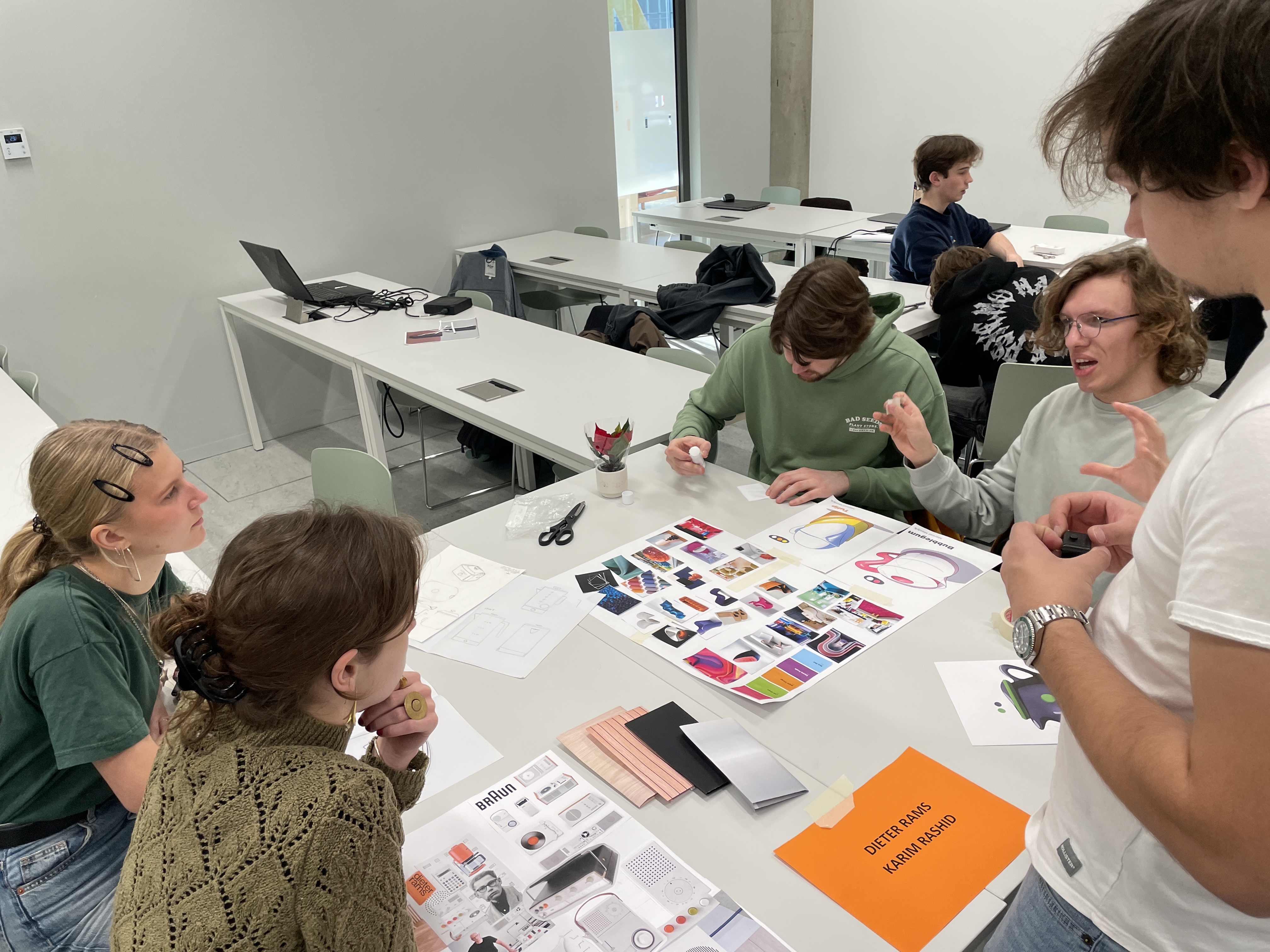
- US: The course Design <> Research taught me and made me try out critical methods used for design research but also explorative goals. Methods are semi-structured interviews, observational studies/schemas, and diary studies/probes. I also practiced with thematic analysis and coding. This course has reignited some interest in the domain of US for me.
- MDC: Both through the course Digital Craftsmanship and P3 I have explored the use of data and data-powered tools to inform my designs and design decisions. I practiced more data-oriented thinking by developing the ButtonLib for analyzing higher quantities of prototypes and related workflows in P3.
Overall Competency of Designing
I have improved in:
- More exploration-oriented thinking and designing instead of goal-oriented.
- Communicating my designing through high quality material such as photographs and pictorials.
- Exploration of a multitude of different methods of fabrication and crafting for both end-product and prototyping.
- Detaching myself from my designs and feeling more open to exploring and prototyping rather than sticking to a main idea.
I see opportunities for myself in:
- Adhering to and crafting a system for each design project.
- Being less frustrated and feeling less accountable for every part of a project.
- Structuring my projects and development in a way that I can showcase it to assessors and professionals within design better. Focus on clarity and story.
I wish I could have done this earlier:
- Created templates for posters in Design <> Research.
- Let team members fill the spaces of projects rather than volunteering to do everything, this caused disconnect and conflict with intentions.
- Limited myself less in P3 and focused more on exploration and letting that be the leading part.
- Put less focus on MDC, I feel a bit burnt out from it.
Personal Projects
In my off-time I also work on design, IT, and art related projects. Currently I am looking at restructuring both my personal and ID related websites using Hugo, an open source content management system which would allow me more freedom and expression than my websites currently. I also want to return to 3d printing more ideas I have for electronic-integrated designs I am working on with another person, where I am the expert in terms of design (processes), UX, and modelling/sketching.
Vision on Design
Vision Statement
Designers are extremely relevant in the fabric of society, and we are able to contribute to it in many ways. Particularly because of Zuzanna Skalska's lectures I have become more sensitive to this part, and I have realized the importance of staying in tune with life as a designer and how big of a moral obligation it is to design for and with the right people for the right purposes using the right methods. Designers always work in a team, alone we are just merely craftspeople, and that is something I bring with me into my vision of design in the future. We are experts on connecting people, technologies, materials, and products, and we must stay sensible to why and how we do that.
Areas of Interest
- Local Materials
- Open-Source
- Modular Designing
- Product Lifecycles
- Designing for Reuse
- Cradle to Cradle
How this shows in my work:
- The design research related vision is reflected in my preference for more open-ended projects, material-led exploration, and the development of systems such as ButtonLib, where the outcome is not a single product but a reusable design structure for future designers.
- Most of my work for P3 was entirely done on open-source software, meaning anyone could replicate the same things I have worked on. I feel this is an important responsibility as a designer.
- In my P3 report I invite the reader to download my materials and play with them. This integrates with what I find important in open-source and designing for reuse. Designers are never done designing, even if something is considered "final" it can always be iterated on, even by someone else.
Professional Identity
Current Identity
Who I am as a Designer
I position myself as a material-forward and data-oriented research designer focused on exploring materials and documenting my findings in self-made and open-source systems. I like designing using my intuition as a design professional and previous experiences, but also like to use more rigorous methods connecting to design research and human-centered design practices. I notice I love figuring out things I don't necessarily have a grasp on yet, especially when they are multi-modal and highly physical. Design probes, diary studies and placing myself in certain settings using materials, objects, pictures and scenarios as a designer is what I love doing.
Strengths
- More experience with unfamiliar advanced materials in open-ended scenarios where exploration is valued.
- Communicate and easily connect with people in certain fields of interest regarding projects.
- Designing for repeatability, documentation, and future use.
- Visual communication through high quality photography and highly visual pictorials.
- Ability to put everything in words and look at the bigger picture of a project.
- Focused on documentation and documentation-related systems within a project.
Challenges
- Tendency to take on too much responsibility in group settings.
- Balancing depth of exploration with time constraints.
- Setting unnecessary limitations and rules/systems on myself in the opening phase of projects instead of openly exploring and documenting as I go.
- Pondering on perfectionism too long instead of exploring.
Future Development
For the future of my professional identity development, I want to focus more on the following topics:
- Become even more comfortable as a designer handling abstract and long material explorations without panic or burnout through more experience and adhering to structural parts like research questions, theories and methods, which I learned through feedback on P3 and Design <> Research.
- I also want to become more deliberate in moments of leadership rather than becoming a leader purely by most involvement with the project. I am good at helping members of my teams discover how to contribute and become vital to the project, this shouldn't turn into me telling people what to do.
- I want to learn how to strike a balance between my systematic designing tendencies and free/creative designing based on intuition and feeling. I feel that this will come with more experience and critical reviewing on projects, which both this document and P3 are helping me with.
Direction
I still have a year and a half left on my bachelor study, of which next year is an internship and a final bachelors project. I think it is important I start evaluating and dissecting what factors I find important in undertaking a decision for these aspects and what to do after I graduate.
For a future option to be viable I should consider:
- Relation to materials
- Exploration vs solution orientation (is my job to explore as a design research expert or am I expected to come up with specific solutions?)
- Systematic design (how far in the design process is my work? can I design systems?)
- Ethics and my vision for society (not working for a company/institution that does not morally align with me)
Goals
G1: Material Research Structure
I want to become more comfortable sustaining long, abstract material explorations without burnout. I want to do this by learning how to incorporate a lightweight structure I can follow that doesn't limit my exploration.
- In exploratory or material projects I will define a guiding research question, framework, or hypothesis before I start fabricating and moving beyond the conceptual work.
- For my upcoming projects, either personal or university related, I will document the research framing I implement and how it helped or if it hindered and in what way.
- I can change or remove the framing if it proves to be unhelpful.
G2: Exploration of Academia & Practice
I want to explore more thoroughly what my future should become after my bachelors. I need a way to talk and document my doubts progress and intentions like I do in my PDP.
- Talk with professionals from both aspects on this topic, this could be people from my research cluster or maybe a topic I could interview people about on my internship.
- Use my Direction part of my PDP to reflect and adjust based on my experiences.
G3: Leadership & Role in Projects
I want to become more deliberate in my role in group projects instead of becoming the leader through my passion or early dedication to the project.
- At the start of each project I should define my role and discuss it with the group.
- Reflect on role division half-way through the project and see if it shifted and why.
- Roles can always shift but it shouldn't happen unaware or without good intent.
G4: Finding Inspiration in Life
As described in my vision designers should be grounded in reality, should experience life, and find inspiration anywhere. This was something Zuzanna made me realize and I think it is one of my most important goals.
- Instead of scrolling through Instagram or looking at YouTube I will choose something to do out of a predefined list of sources I will make for myself. Zuzanna shared a list of podcasts, sources for designers, and listed things to do as a designer which I want to keep track with.
- If possible, I want to write very small quick sentences on what I saw and what I think of it.
- I am not specifying an amount of time as every activity takes a different amount of time, but it is something I will set myself up to do daily.
G5: Design Porfolio
I am currently looking at developing my personal and ID related websites through Hugo and hosting them on Cloudflare Pages. I wanted to write these down as formal goals as they are related to PI&V and ID as a whole.
- Transferring my website to Hugo gives me more freedom on deciding the layout.
- Hugo is fully open-source, it fits with my motivations and is something I can develop.
- It could lead me to a potential future of becoming a web designer.
My goals are intended as directional anchors rather than fixed endpoints. I will revisit and adjust them as my understanding of them and my ambitions evolve.
See more in Activities Overview.