Reflection on Futures Thinking
Before the Course
Entering the course I expected Futures Thinking to introduce me to a new frame of thinking, one that is tuned to develop a sensibility for the future, as designers it seemed to me that taking the future into account is a big part of what differentiates a good designer from an ordinary one, and I have been eager to learn about this from Zuzanna. I expected a more open atmosphere compared to other courses, as the topic isn't as straightforward as say; calculus or physics: do x to get y result and pass the course. Futures Thinking to my expectation was that I the designer, and my interpretations on things gives an array of possible outcomes or results, which is what makes a designer so crucial in a team.
Process of Development
I see my development during this course in three stages. In stage 1 I got introduced to Futures Thinking by Zuzanna, and mostly tried to get a grasp on what the elective is about, tasting it out so to say. Stage 2 is a bit more directional, and I start to add my own twist to things and trying to develop certain parts myself whilst also learning of how other designers do things their way.
Early Sessions: Getting a Grasp
This section to me is the first two sessions we had with Zuzanna. I called it this way because in the first few lessons we get the background information/theory to form a conceptual understanding of what this elective will and will not be. We got reintroduced to the design squiggle which served as a metaphor to showcase what part of the process Zuzanna is an expert on. To me this is one of the things I most recall, along with how politics, completely different markets,
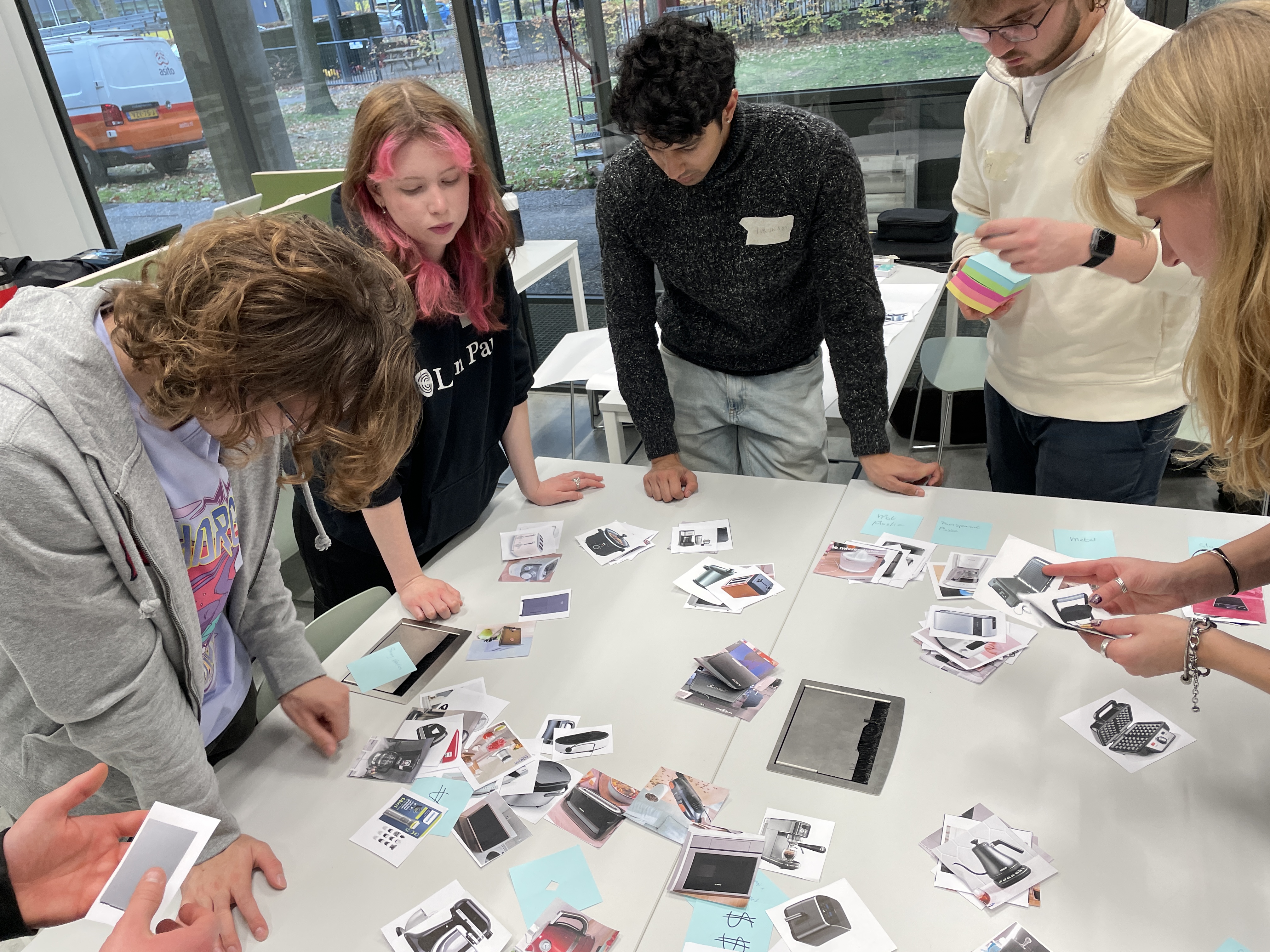
Sensitivity for design and different shapes gets curated, especially though workshops like the collecting of different kitchen appliances (picture below), and analyzing them based on different CMF-related aspects which play a role; especially within the kitchen appliance world which was the metaphor/aquarium which we were put in as future designers. By sensitivity I mean the awareness of us designers to disassemble designs into its designed parts, like what color, material, UX/UI is used in combination with the brand identity to form a coherently designed image.
Something that I vividly recall from these formative sessions is that us designers will never be able to be consumers again. We are trained to look at products from a different view, and we are trained to be able to look past what image is created of products. I noticed this has significantly changed me in the long term, as I am developing a critical eye to deconstruct products and look at them from the perspective of the designers.
Middle Sessions: Different Methods and Deepening Understanding
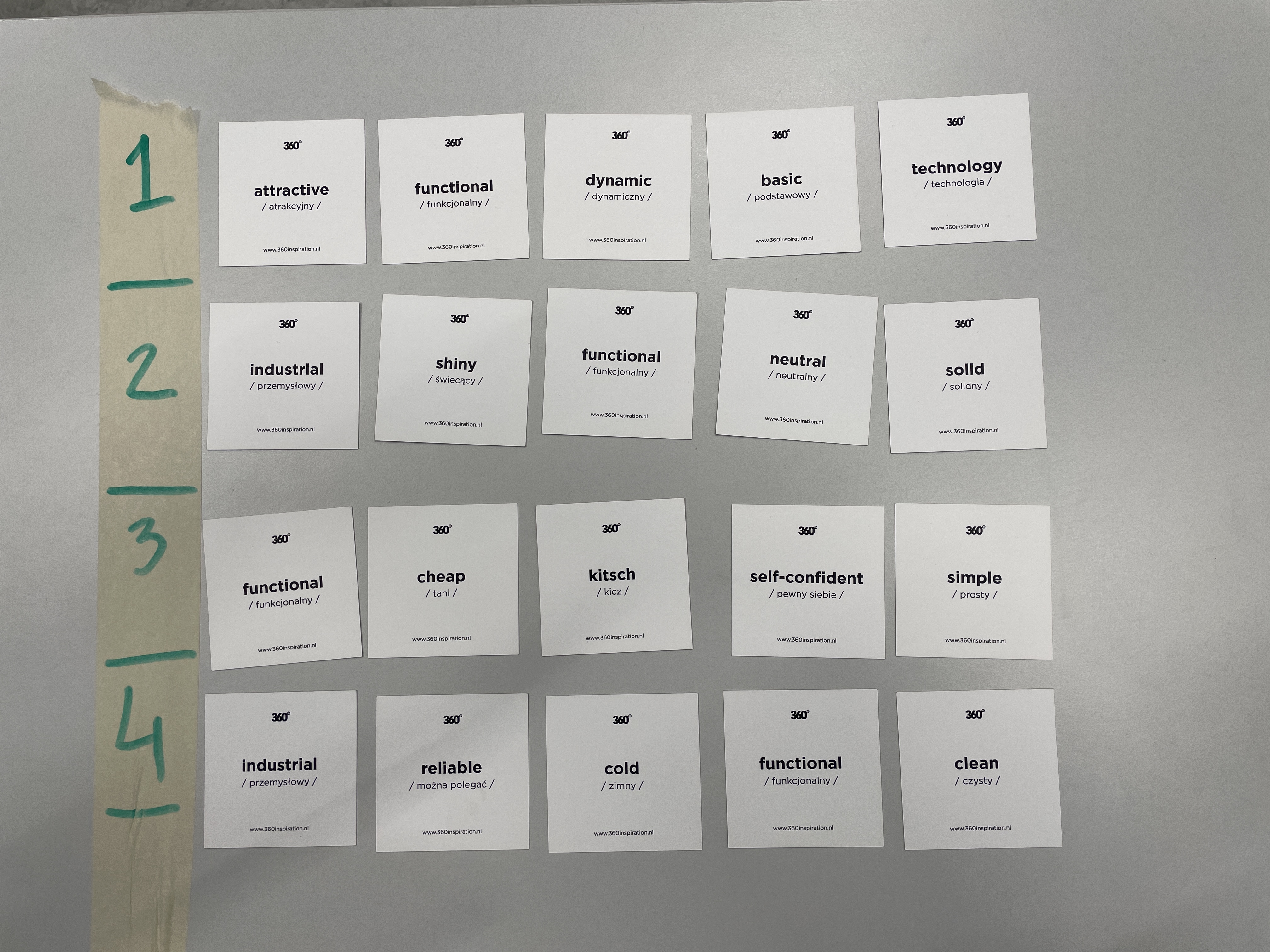
This middle section starter for me from the point we looked at four different hypothetical futures based on a paper we had to read. At this point we get introduced to different perspectives from different people. For this workshop I brought works that I made using three techniques; digital painting, photobashing, and 3d modelling/rendering. I used this time to thus also develop these skills and give myself a refresher on how they work, this could be useful for me in the future as a designer. A shift has also occurred where I started to more critically assess these new theories and relating them to my personal development as a designer. I was particularly intrigued when Zuzanna showcased to us how her design process looks like, with a very large amount of physically printed material that can be rearranged and debated on. Another interesting "technique" was the word cards that we got to experience (picture below). All these methods are, in my experience and view, focused on refining the design process and being able to connect it with the client. Where the client is not the end-user but the company that hires you, which was something that stuck with me as well.
After being assigned a designer to introduce to the rest of the group in a workshop, I saw it as my task to bring through the visual style and "feel" of this designer's trademark over into the presentation. This was also based on what I learned during the course of distilling aspects such as coloring, materials and finishing, but in the context of graphical design with mostly typography and color. This was a good and fast assignment which allowed me to quickly distill the most important parts to showcase about the designer from my point of view.
Later Sessions: Positioning of Designers and The Future
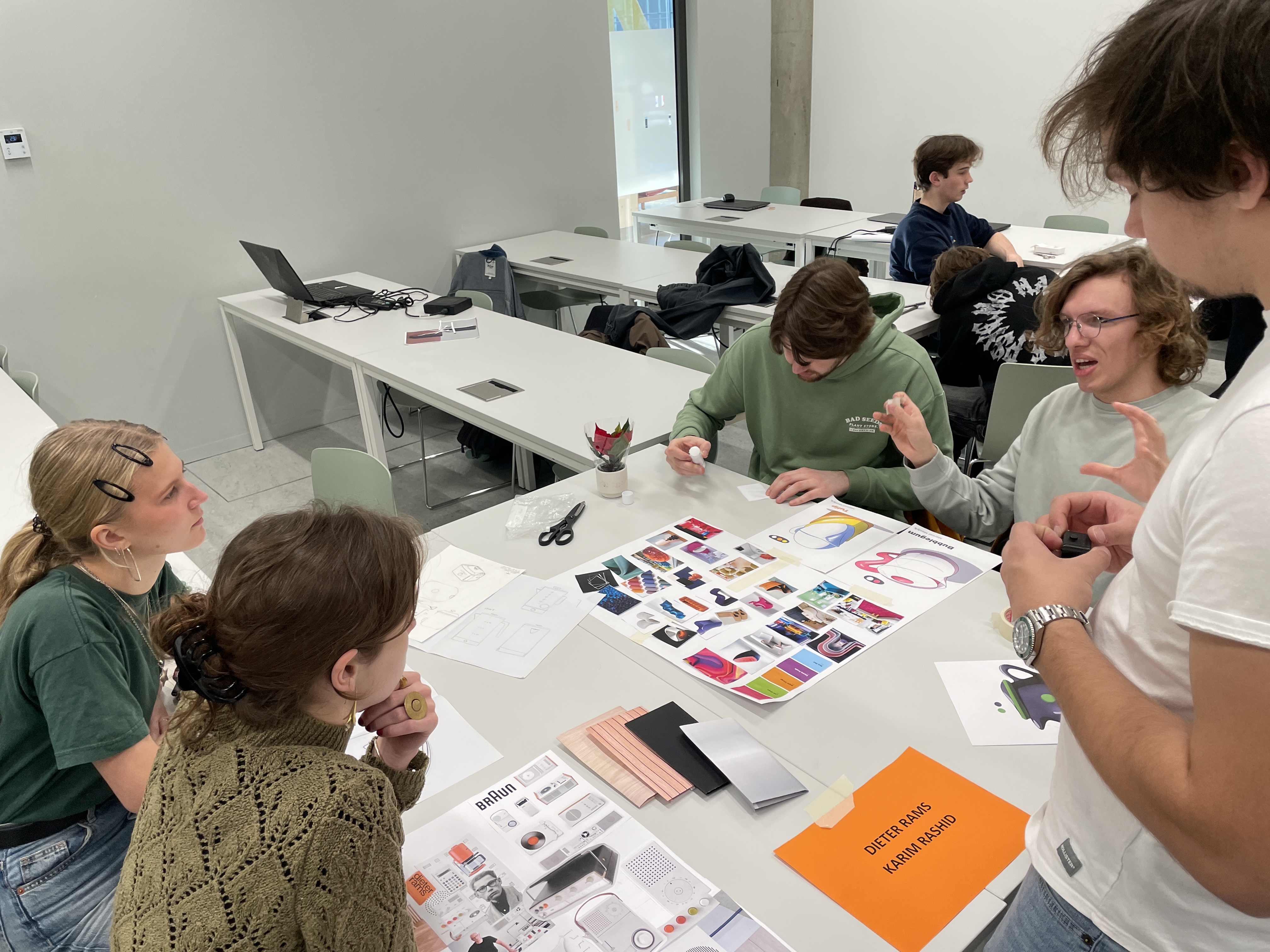
Specifically the last two sessions with Zuzanna, and the variety of design-related personal talks we have had during the course for me fit into this last section, where our craft is put in the context of the world and what we are and aren't responsible for. To me this was the biggest point of learning and something I will specifically remember this course for and reflect on even more in the future. Designers have moved beyond just designing chairs and lamps, we are becoming more and more important within society itself, where everything has to be designed even if the general public doesn't consider it so. Zuzanna gave us a valuable overlook of what it's like to be a designer within the real world through metaphors such as the 12 designers we were assigned to in the different workshops at the closing phase of the course. The CMF board we had to make together with sketches, and the "bashing" of two designers into one product is a good example of how I got to apply what I learned and discuss this within a team of talented individuals in this course (picture below). Solo designers are craftspeople, true designers work in a team of variously skilled people and make sure to get the most out of every person.
I felt a big uncertainty up to this point in terms of the direction I wanted to move into as a designer, I was interested in pursuing a PhD but I had a lot of doubts on that considering that academia doesn't exactly fit me or my views as a designer. Having participated in the lessons, read the material, and having had interesting conversations with Zuzanna herself I have come to realize that I would want to find a good internship and start gaining job and designing experience right after my bachelor instead of doing a masters or pursuing a PhD. I have learned through this course that I cannot work disconnected from the world in academia, I would rather work for real clients in real markets than write literature.
Elective
To summarize this elective for myself, it put the subject of (product) design into the context of the real world. It showcased us how certain thinking patterns and habits work and don't work in the real world in relation to what we have learned thus far in the bachelor. It also very much destroyed the egocentricity and protectiveness of ideas and designs I feel is present within our faculty; by that I mean that people tend to exaggerate their solutions and products to a point where it feels detached from reality. This elective showed; great ideas don't come from nothing, they're iterated and they're the results of an immense amount of effort from tens or hundreds of people who are experts in their craft. To consider your own idea better because you like it more is ignorant.
After this elective I also feel more confident and prepared for real world designing beyond the study itself. I feel like I have been given the right tools and materials to develop myself further as a designer: make connections, be curious about things, explore the world around me as a designer and take it in with a critical eye. I am very eager to showcase my learnings in an internship and further develop my skills there.
Key Learning Moments
- Designers will never be consumers, they fundamentally look different at products and understand what goes on beneath the created façade of a product.
- The End-User is not the client, but the user should still inform the design process. You design for the client, which is the company that hires you.
- Designers never work alone, we always work with someone for someone.
- Kill your darlings, ideas are thousands, only a few will truly be better, and it's never the first.
Museum Visits
Evoluon - Next Nature
Entering the museum I wasn't exactly sure what RetoFuture would entail, my expectation was that it would be a chronological overview of the past and the expected future based on the showcased works. Instead I explored many different facets and ideas from the past and how people from the past thought the future would look like.
What struck me the most was the optimism in most of the showcased works and futures. People were thinking of pinnacle breakthroughs in housing, food, health, and mobility. Especially with the architecture and mobility part of the exhibitions I was touched, it reminded me of being younger and having so many ideas for how I would solve all these issues; the child-like optimism I used to have.
I left the exhibition with mixed feelings, mostly because these were beautiful ideas and works that the majority of the world feels indifferent to because of all the modern turbulence and uncertainty we have now.
As a designer, I got reminded that big bold and absurd ideas like the sky cities or underground houses shouldn't be disregarded. Absurdity and big ideas fuel us designers, we shouldn't feel limited by what reality only tells us we can make. Many of the predicted technologies weren't possible or didn't exist yet when they were thought of in the showcased works, and that is the beautiful thing of us designers, we are only limited by our creativity in what we make.
DAF Museum - Heritage & Horizons
Out of the exhibitions we had to visit I was looking forward to this one the least. I have very strong feelings about generative AI, especially with regards to art and sketching. Regardless of this I tried to maintain an open mind and explore the showcased AI as a tool, rather than a threat.
I was surprised at how much of the exhibition actually showcased the design process and process sketches of older and newer DAF designers. I really liked the human drawn sketches and being able to see them physically in the trucks behind.
The AI part felt a bit too gimmicky for me if I want to be honest, I get that it is a tool that can help a designer make more in a shorter time, but the first and last part will always be done by a human, not a robot. It feels like everything has to be covered in a layer of AI nowadays which I find very unfortunate to be honest. It felt like the exhibition was trying to advert their sponsored AI software which I didn't exactly enjoy. I love the layout of the exhibition and the human made aspect, but not exactly the AI.
Despite my personal feelings on AI I am also aware that disregarding it fully is also not an option as a designer. AI is a good tool if used properly, and it will be more prominent within the field in the future. Having at least a basic fluency in prompting and using different AI-powered software will be valued, even though I see myself as a more artistically trained designer and would rather sketch everything by myself. I just need to be able to find good ways to use AI which can enhance my workflow instead of replace it or hinder it.
Design Museum Den Bosch
I did not read a lot about the exhibitions beforehand, meaning I went into the museum unknowing what exactly I would see. I was interested in seeing the Bauhaus to Makkah exhibition as the name seemed to contrast and intrigue me. The museum showcased different curated designs which I thought were interesting, though it felt very conceptual and higher-level design than the other museums I went to. I think this contrast is interesting even though it wasn't exactly the kind of design I like. They felt more like artifacts than products.
I however really enjoyed the part about Dr Mahmoud Bodo Rasch in the "From Bauhaus to Mecca" exhibition. I actually knew the architect from documentaries beforehand so I already had a good introduction, what intrigued me most is how unknown this architect is in the western world. It reminded me of the lessons we had and how the powers will most likely shift from west to east, and thus designers and architects from more eastern regions will gain more prominence in the entirety of the world. I think this is interesting as the view of design is usually very classically western or contemporary western, it misses the perspective of people all across the world, which I was happy to see showcased.
What I wish to take with me from this exhibition is that design is not only a "western phenomenon". Design is universal and respects to be treated that way too. Markets will turn towards eastern markets eventually, requiring knowledge on different customs, cultures, religions than what we are used to seeing here in the west. I want to be open to experiencing and seeing different cultures for this sake.
Signals of Change (Reports)
Topic of Interest
Trends of people and lifestyles.
I chose this topic as I wanted to see if there are any overlaps in how these reports perceive people and the overarching trends of how people go about their life.
Reports
- Expedia Unpack 2025
- Accenture Life Trends 2025
- Aeroplane Branding Trends 2025
Key Aspects (Signals)
- AI
- Authenticity
- Real vs Fake
- Digital Detox
AI
AI is a big topic within a lot of campaigns in general, but also in the three analyzed reports. Companies want to streamline everything with AI, though the general public tends to get tired of seeing it everywhere. In the future I predict AI will still be very popular, but less obvious in its appearance. It will take a background role in campaigning and processing data. Advertisements made by real people promising things are more effective at getting the point across.
Authenticity
People want a lifestyle that is very much their own. Originality is something people seek after rather than living like celebrities or influencers. Standing out means to be bold and bright. People want to be interesting and the center of the discussion, whether that is their personal trip to the other side of the world, or the products they own. People are impatient and assertive in how they navigate life, which is a big motivator seen in this shift.
Real vs Fake
With AI Deep-Fakes and AI scams, people are more vigilant about giving their trust. Trust is the new currency in the world, and companies need to handle it as such. People are more willing to trust bold and trustworthy brands that have a good reputation of being loyal and true to their word.
Digital Detox
With the prevalence of smartphones people more and more seek alternatives and escapes from their day-to-day life. Especially among gen-z, "detoxing" from the internet is seen as an act of healthiness, like dieting was a trend years ago.
Letter to the Future
Seeing the world develop worries me. It feels like our generation is getting desensitized to many of the puzzling issues this world has. People rather hide behind their digital screens all day seeking distractions from boredom than put in the effort to connect and empathize. The world itself seems to be heading into a dire state from a western point of view. I think it is important in these times to stay open and curious, talk to people that have different perspectives on things, and be able to listen with an open mind instead of ignorance. I got reminded of my English teacher who introduced me to so many different perspectives around the world through the literature and bodies of work we had to read. I wish to reintroduce that into my routine, become curious again instead of scared and indifferent. Being scared of the future isn't going to change it.
I want to keep in touch with my designer friends from all over the world, hear out their perspectives and learn together with them. I want to share my knowledge with them as well and get them inspired.
I will always want to stay open for opportunities and collaborations. Not asking for something means you'll certainly never get it, and I wouldn't have acquired the skills and opportunities I have now if I didn't have the courage to ask for them to the people I look up to, whether they are skilled designers or artists, or anyone else that could open me up to a new opportunity.
Be open - Be curious - Be inspired to create.
Go back to Futures Thinking.